Sponsor guide
NHRC and DDA approval in Nepal: what to check when choosing a CRO
How Nepal Health Research Council (NHRC) ethics review and Department of Drug Administration (DDA) permission fit together for a clinical trial, how to test whether a CRO in Nepal can manage both, and how Nepal Clinical Research supports studies through them.
Source-based guidance · not a regulatory determination
Explore all insights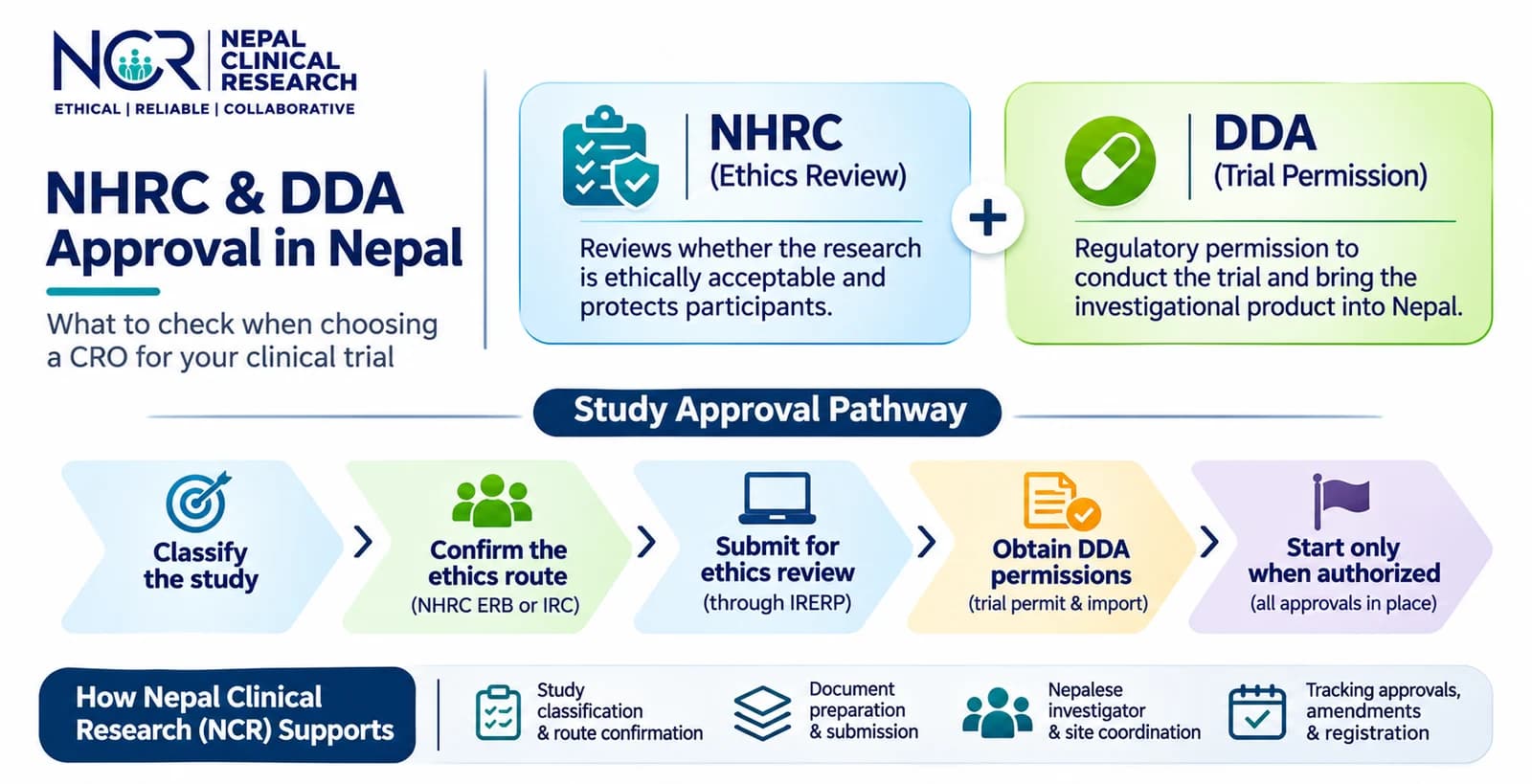
1. Why NHRC and DDA come first when you choose a CRO
For a clinical trial in Nepal, two national bodies make the decisions a sponsor cannot work around: the Nepal Health Research Council (NHRC), which oversees ethics review, and the Department of Drug Administration (DDA), Nepal's medicines regulator. A clinical research organisation (CRO) in Nepal is only useful if it can explain both routes for your specific study and keep the two in step. This guide sets out how the approvals relate and what to ask a CRO to show before you rely on it.
2. Separate decisions, separate records
NHRC ethics approval does not authorize a drug or vaccine trial on its own, and DDA permission does not replace ethics review. Plan each decision with its own documents, owner and written record.
| Approval | Who decides | What it covers |
|---|---|---|
| Ethics approval | NHRC Ethical Review Board (ERB), or a recognized Institutional Review Committee (IRC) within its remit | Whether the research is ethically acceptable and participants are protected |
| Clinical trial permit | DDA | Regulatory permission to conduct the trial with the investigational product |
| Investigational product import | DDA | Authorization to bring the product into Nepal for the trial |
| Institutional permission | Each participating institution | Use of the institution's staff, facilities and records |
3. Which ethics route applies
Nepal has NHRC's central Ethical Review Board and NHRC-recognized Institutional Review Committees. NHRC's 2016 IRC guidelines state that IRCs must forward certain proposals to NHRC for approval, so an institution having an IRC does not mean that IRC can approve your study.
- Research proposed at the national or international level
- Externally sponsored or funded research
- Clinical trials involving human or animal participants
4. Which studies involve DDA
DDA's published role includes issuing clinical trial permits. The permit is described in Schedule 13 of the Drug Registration Rules, 2038 BS. DDA's trial and import role concerns studies with an investigational product; observational research that does not assign one generally falls outside it but still needs the appropriate ethics route. Medical devices follow DDA's Health Technology Product and Equipment Directive, 2074 (2017), and need a product-specific determination. If the classification is unclear, document it for your protocol.
5. Treat the sequence as dependencies
The two routes depend on each other at different stages. Annex II of NHRC's 2022 guidelines asks a trial submission to include a no-objection letter from the relevant regulatory authority, such as DDA for drug and vaccine trials. Section 7.1 of the same guidelines describes an investigational product import licence after NHRC approval. A CRO should map these dependencies for your study and confirm the current order with both NHRC and DDA before anyone commits to dates.
- Classify the study
Observational, interventional, drug, vaccine or device.
- Confirm the ethics route
NHRC ERB or a recognized IRC within its remit.
- Open DDA correspondence
Establish the documents DDA needs for the trial submission.
- Submit for ethics review
Through IRERP, with the trial documents listed in Annex II.
- Obtain DDA permissions
Trial permit and investigational product import, as they apply.
- Start only when authorized
All written approvals and institutional permissions in place.
6. Ask the CRO for evidence you can verify
A CRO's statement that it has managed NHRC and DDA submissions is a claim, not evidence. Ask for material you can check, and assess the people who will actually work on your study.
- The named people assigned to your study, with their qualifications and GCP training
- A written explanation of how your protocol would move through NHRC and DDA, not a generic dossier
- Examples of past submissions or correspondence, shared only with the permission of the organisations involved
- References you can contact directly
- Written procedures for document version control, tracking approval conditions and escalation
- A clear statement of which services the CRO offers now and which it does not
7. Warning signs
Review scheduling, fees and conditions are set by NHRC, DDA and the participating institutions. Be cautious when a CRO:
- Promises approval or a fixed approval timeline
- Treats ethics approval as if it also authorizes the trial or the import
- Suggests recruitment or shipment can start before the written decisions arrive
- Cannot say whether your study belongs with the NHRC ERB or an IRC
- Is unaware that new NHRC proposals now go through IRERP
- Does not mention a Nepalese principal investigator for an international study
8. After approval: keep both records current
Approval starts a set of obligations. NHRC's 2022 guidelines say amendments are requested through the online portal and approved before they are implemented, and clinical trials carry progress, safety reporting and monitoring obligations. DDA permits carry their own validity dates and conditions. Ask the CRO how it will track each approval's conditions, versions and expiry dates, and how changes will be reflected with both bodies.
9. Responsibility stays with the sponsor
Under ICH E6(R3), a sponsor can transfer trial-related activities to a service provider but keeps overall responsibility for the trial. Agree in writing which NHRC and DDA activities the CRO will perform, how you will review its work and what evidence will show completion.
10. How Nepal Clinical Research supports your study
Nepal Clinical Research (NCR) is a clinical research organisation (CRO) based in Nepal. We take studies for sponsors and CROs through Nepal's regulatory and start-up steps, from study classification and NHRC ethics review to DDA permission, trial registration and identifying a qualified Nepalese investigator and site. For NHRC and DDA, that means coordination and submission support; the decisions remain with NHRC, DDA and the participating institutions.
- Classifying your study and confirming whether review belongs with the NHRC Ethical Review Board or a recognized IRC, and whether DDA authorization is required
- Reviewing documents against the current checklists and tracking gaps before submission
- Version control for the protocol and participant materials, including Nepali-language consent documents
- Coordinating investigator and institution documentation, including the Nepalese principal investigator arrangements
- Preparing the NHRC submission through IRERP and the DDA-related documentation where it applies
- Tracking responses, correspondence and approval conditions with both bodies
- Coordinating amendments, renewals and final reports
- Planning trial registration alongside ethics review and DDA permission
Common questions
Clarify the scope.
Does a clinical trial in Nepal need both NHRC and DDA approval?
A drug or vaccine trial generally needs ethics approval from the NHRC Ethical Review Board or a recognized IRC within its remit, plus DDA trial permission and investigational-product import authorization. Observational research without an investigational product generally falls outside DDA's trial role. Confirm the classification for your protocol.
Which comes first, NHRC or DDA?
They depend on each other. NHRC's 2022 guidelines ask for a regulatory no-objection letter, such as from DDA, with a trial submission, and describe an import licence after NHRC approval. Confirm the current order with both bodies for your study.
How can I check a CRO's NHRC and DDA experience?
Ask for verifiable evidence: the named people on your study and their training, a study-specific explanation of the route, examples shared with permission, and references you can contact. Treat unsupported claims and guaranteed timelines with caution.
Can a CRO guarantee NHRC or DDA approval?
No. Decisions, fees, scheduling and conditions belong to NHRC, DDA and the participating institutions.
How can Nepal Clinical Research help with NHRC and DDA approval?
NCR coordinates the regulatory and start-up steps for sponsors and CROs: study classification, the NHRC ethics submission, DDA-related documentation, trial registration and identifying a qualified Nepalese investigator and site. NCR does not make or guarantee approval decisions; those rest with NHRC, DDA and the participating institutions.
Editorial disclaimer. This article is general guidance based on published NHRC, DDA, Nepal Law Commission and ICH sources. It is not a regulatory determination. Confirm current requirements, forms, fees and sequence with NHRC and DDA for your specific protocol and product. Last researched: 17 October 2026.
This guide is educational and based on the public sources it cites. It has not been reviewed by an independent regulatory specialist, and it does not replace a protocol-specific decision by NHRC, DDA or the responsible institution. To report an error or an out-of-date requirement, email info@nepalclinicalresearch.com.
Sources and further reading
Additional Resource
- NHRC — National Ethical Guidelines for Health Research in Nepal (2022)
- NHRC — Guidelines for Institutional Review Committees (2016)
- Department of Drug Administration — Regulatory role
- Nepal Law Commission — Drug Registration Rules, 2038
- DDA — Health Technology Product and Equipment Directive, 2074 (2017)
- ICH — E6(R3) Good Clinical Practice, Principles and Annex 1 (2025)
- NHRC — Notice: Submission of New Research Proposals Through IRERP (24 June 2026)
Related pages

Plan your study
Planning a trial that needs NHRC and DDA approval?
Share a non-confidential study synopsis and we can discuss the ethics route, DDA requirements and the start-up steps your study needs in Nepal.