Research ethics guide
How to Obtain NHRC Ethical Approval in Nepal: Complete IRERP Research Proposal Submission Guide (2026)
Learn how to apply for NHRC ethical approval in Nepal through IRERP, including research proposals, required documents, IRC review and clinical trials.
Source-based guidance · not a regulatory determination
Explore all insights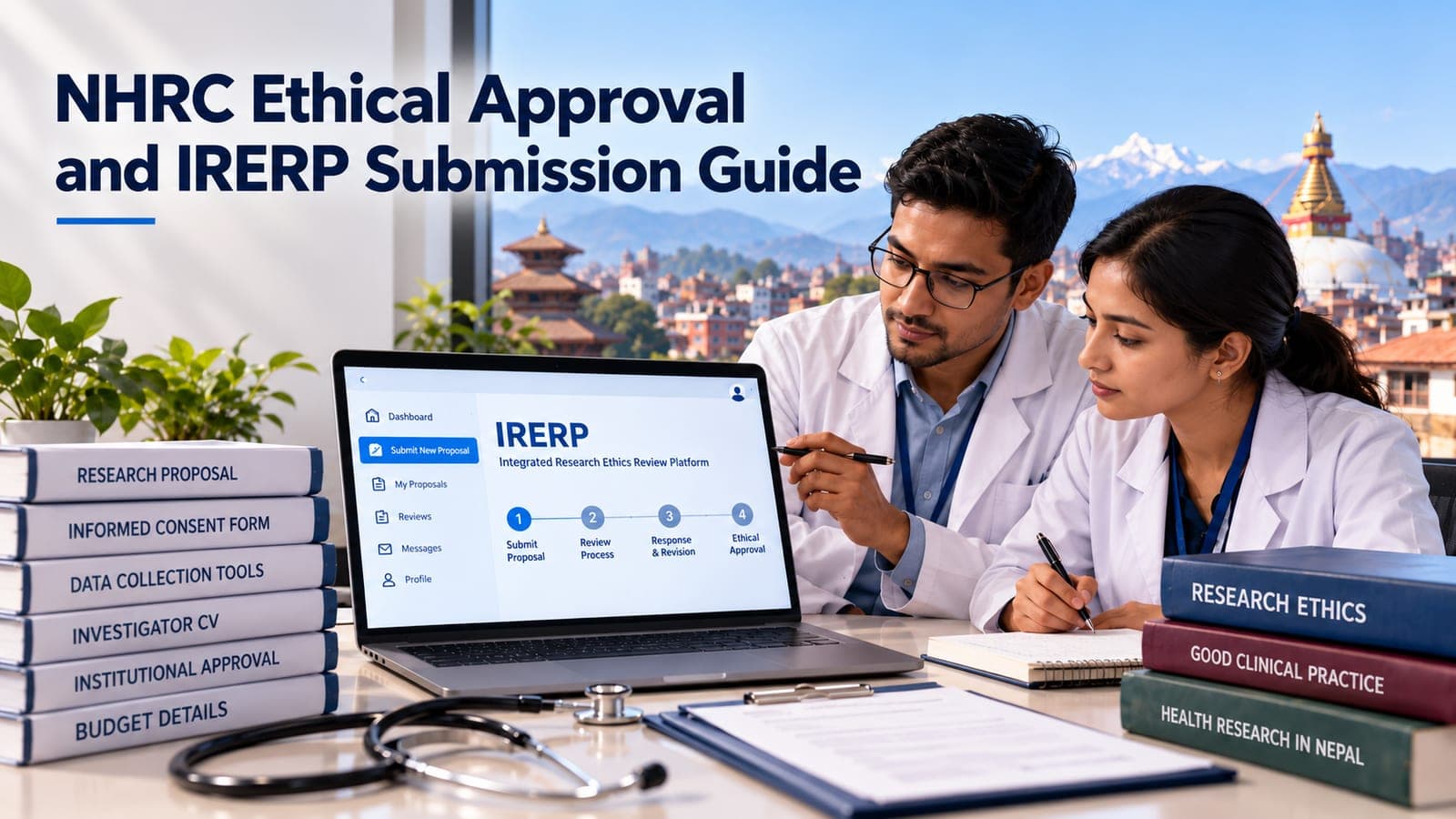
Overview
Research involving human participants requires careful scientific and ethical review before it can begin. In Nepal, the Nepal Health Research Council (NHRC) plays a central role in setting ethical standards, reviewing research proposals and overseeing the protection of research participants. In 2026, NHRC changed how research proposals are submitted. New proposals that need NHRC ethical review must now go through the Integrated Research Ethics Review Platform (IRERP), which replaces the previous online ERB route for new applications. This guide explains how to apply for NHRC ethical approval: choosing the right ethics review committee, preparing a research protocol, assembling submission documents, registering on IRERP, responding to review comments, and the additional requirements for clinical trials and international research.
- Principal investigators and academic researchers
- Postgraduate students and their supervisors
- Hospitals and research institutions
- Clinical trial sponsors and contract research organizations (CROs)
What is NHRC ethical approval, and why does it matter?
NHRC is the national institution responsible for supporting, coordinating and promoting ethical health research in Nepal. Its ethical review framework is designed to ensure that research is scientifically justified and that the rights, safety, dignity and well-being of participants are protected. Ethical review is particularly important when a study involves human participants, personal health information, clinical interventions, biological specimens, or populations that need additional safeguards. NHRC's National Ethical Guidelines for Health Research in Nepal (2022) provide the principal framework. Before approving a proposal, an ethics committee may consider whether:
- The scientific objectives and methodology are appropriate
- The anticipated benefits justify the potential risks
- Participants will give informed and voluntary consent
- Privacy, confidentiality and data security are adequately protected
- Investigators have suitable qualifications and resources
- Vulnerable participants receive appropriate protection
- Safety monitoring and research-related injury arrangements are sufficient
What is IRERP, and what changed in 2026?
IRERP stands for Integrated Research Ethics Review Platform. It is the electronic submission system NHRC has designated for new research proposals that require its ethical review. NHRC announced the transition in an official notice dated 24 June 2026. The move is part of a wider effort to digitise ethics review in Nepal. In December 2024, the World Health Organization and NHRC signed a memorandum of understanding to create a national online ethical review system, aimed at streamlining and standardising the review process.
| Submission situation | Appropriate platform |
|---|---|
| New proposal requiring NHRC ERB review | IRERP |
| Proposal submitted before the migration | Legacy ERB portal |
| Revisions to a pre-migration ERB proposal | Legacy ERB workflow |
| New investigator with an existing ERB account | Register a new IRERP account |
| Proposal within a registered IRC's authority | The institution's own IRC process |
The review board and the platform are different things
Ethical Review Board (ERB) still refers to NHRC's ethics review body. IRERP is the electronic submission platform; it does not replace the board itself. Avoid opening duplicate applications for studies that are already being processed through the previous system. For more on the migration itself, see our summary of NHRC's IRERP notice.
Does your research need NHRC approval or institutional IRC approval?
Identifying the correct ethics review authority is one of the most important decisions. Not every proposal follows the same route: Nepal has both NHRC's central Ethical Review Board and NHRC-recognised Institutional Review Committees (IRCs).
NHRC Ethical Review Board (ERB)
NHRC's ERB reviews proposals within its jurisdiction, including categories that institutional IRCs are not authorised to approve. NHRC's 2016 IRC guidelines state that IRCs must forward the following proposals to NHRC for approval:
- Research proposed at the national or international level
- Externally sponsored or funded research ("externally" means outside the country or outside the particular health facility or institution)
- Clinical trials involving human or animal participants
Institutional Review Committee (IRC)
An IRC is an ethics committee established within an institution and recognised by NHRC. The 2022 guidelines describe IRCs as reviewing proposals with less than minimal or minimal risk submitted by the institution's students, faculty and staff. The 2016 IRC guidelines add that an IRC is not authorised to give ethical clearance to proposals from researchers outside its institution. An IRC's existence therefore does not mean it can approve every protocol. For multicentre studies at institutions that have IRCs, the 2022 guidelines describe a joint review led by the ERB with IRC representatives.
How to determine the correct route
Before submitting, establish:
- Whether the study is health research that requires ethical review
- Whether your institution has an active NHRC-recognised IRC
- Whether that IRC is authorised to review your specific study category
- Whether the proposal involves external sponsorship, multiple sites, investigational products or other factors that require NHRC ERB review
- Whether separate institutional or regulatory permissions are needed
Documents required before applying
Complete, internally consistent documentation is one of the most important parts of a submission. Annex II of NHRC's 2022 guidelines lists the basic information and documents for online proposal submission (pages vii–ix). IRERP may request additional or differently organised documents, so follow the requirements shown for your specific application.
A. Research protocol and scientific documentation
The protocol should describe the scientific basis and practical execution of the study: title, background, justification, objectives, hypotheses where applicable, design, setting, population, eligibility criteria, sample size and its justification, sampling method, data collection, analysis plan, limitations and expected outcomes. It should also explain how the study will be supervised, monitored and managed.
B. Administrative and investigator documentation
Prepare current CVs for the principal investigator, co-investigators and other team members, highlighting academic qualifications and research experience, along with institutional affiliations. Annex II also lists photographs and scanned signatures of the PI, co-investigators and team members (in JPG format) among the administrative materials. Check whether IRERP requires them in the same format.
C. Participant information and informed consent
Prepare participant-facing documents appropriate to the study: a participant information sheet, informed consent form, assent documents for eligible minors, and any additional consent arrangements. They should explain the study's purpose, procedures, risks, benefits, voluntary participation, withdrawal, confidentiality and contacts. NHRC's guidelines call for consent forms in Nepali and, where needed, the relevant local language, with a date and version number. The application should also describe how information is given, how consent is obtained, who obtains it and how signatures are documented.
D. Research tools and supporting documents
Depending on the design, supporting files may include:
- Questionnaires, interview and focus-group guides, case report forms and observation checklists (in Nepali and local languages where necessary)
- Data management and analysis plans
- A work plan and research budget, including the total budget to be spent in Nepal
- Letters of support from the hospitals or institutions where the study will run
- Donor or funding agreements for funded studies
- Approvals or support letters from collaborating centres
- Other documents required for your research category
E. Additional requirements for specific research
International collaborations, clinical trials and studies that transfer biological samples overseas have further requirements, covered in the sections below.
Step-by-step: submitting a research proposal through IRERP
This workflow combines NHRC's confirmed migration instructions with the submission requirements in its ethical guidelines. The exact screens inside the logged-in portal could not be independently inspected, so follow the portal's current instructions where they differ.
- Determine the ethics review authority
NHRC ERB or a recognised institutional IRC.
- Prepare your protocol and documents
Scientific, administrative and ethics documents.
- Register and log in to IRERP
A separate registration from the legacy ERB system.
- Complete the proposal application
Enter study details and upload documents.
- Confirm the fee and submit
Follow the portal's current instructions.
- Ethics review and revisions
Respond to screening and reviewer queries.
- Written ethics decision
Start approved activities only after all required authorisations.
Step 1: Confirm eligibility and the review route
Determine whether your project needs review by NHRC's central ERB or an appropriately authorised IRC. For a clinical trial, an internationally sponsored project or any other study outside IRC authority, confirm the NHRC route before starting the application. If your research is eligible for IRC review, get your institution's instructions rather than assuming every project goes to the central portal.
Step 2: Prepare the complete proposal package
Finalise the protocol and assemble all supporting documents before starting the online submission. Make sure the study title, principal investigator, sites, recruitment targets, consent procedures and budget are consistent across documents. For example, the protocol should not say 200 participants while the participant information or application describes a different number without explanation. Use consistent version numbers and dates, and name each file clearly so reviewers can tell the current protocol from earlier drafts.
Step 3: Register on IRERP
Go to the official IRERP portal and create an account. Researchers with accounts on the previous ERB system must register separately for IRERP. Provide accurate personal and institutional information, complete any verification the portal requests, then sign in. Verification note: the separate-registration requirement comes from NHRC's 2026 notice. The registration fields, verification screens and account workflow could not be independently inspected without access to the live, logged-in portal.
Step 4: Start a new proposal
After logging in, NHRC's notice says to use the "Submit New Proposal" button at the bottom-left of the dashboard. The layout may change as NHRC updates IRERP, so follow the current portal rather than screenshots of the old ERB system.
Step 5: Enter the scientific and administrative details
Based on the Annex II requirements, expect to provide information on:
- The principal investigator and research team
- Title, objectives, methods, design, population, sampling and data analysis
- Participating institutions and study locations
- Recruitment and informed consent
- Risks, benefits, privacy and ethical safeguards
- Funding, sponsor information and the research budget
Step 6: Upload the supporting documents
Upload the protocol, investigator documents, data collection tools, consent materials and institutional letters as instructed, plus the additional files for funded studies, international collaborations and clinical trials. Check each upload is complete, readable and the correct version before moving on. The Step 5 categories come from the national guidelines; they are not a confirmed copy of the current IRERP field sequence.
Step 7: Confirm the ethical review fee
Annex II states that the ethical review processing fee follows NHRC rules and regulations as described in its SOP, and can be deposited at the NHRC office or a designated bank account. A current, universally applicable IRERP fee could not be verified. Before paying, confirm with NHRC or the portal: the amount, your researcher category, any budget classification, the accepted payment channel, and whether proof of payment must be uploaded. Do not pay into an unverified account or rely on an old fee schedule.
Step 8: Review and submit
Check that the protocol and documents are complete, consistent and current, then submit through the portal. Keep any confirmation, reference number, acknowledgement and the submitted document versions. If no acknowledgement appears, confirm the application was actually submitted and is not still a draft.
Step 9: Respond to screening and review comments
Review may include completeness checks, technical review, ethical assessment and requests for clarification or revision. The 2022 guidelines describe pathways that depend on the risk category, including exemption, expedited review and full-board review. Reviewers may ask for changes to the methods, consent documents, participant safeguards or risk management. Answer every comment clearly, identify the changes made in each affected document, and keep version control when submitting revisions.
Step 10: Receive the decision before starting
A submission acknowledgement is not an approval letter. Wait for the written ethical approval and any institutional or regulatory authorisations the study needs. Then check the approval's conditions: the approved protocol version, sites, participant population, validity period and reporting obligations. Conduct the research according to the approved documents.
Special requirements for international researchers
Nepal offers opportunities for collaborative health research with universities, sponsors, investigators and institutions from other countries. International collaboration also brings additional responsibilities for local oversight, compliance and participant protection. Annex II of the 2022 guidelines states that when the principal investigator is not a Nepali citizen, an additional PI who is a Nepali citizen and relevant to the study subject should be included. The Nepali PI is responsible for all activities in Nepal and for communication and correspondence. Applicants from academic institutions outside Nepal should also provide institutional ethical clearance from their own country. Establish local scientific and institutional responsibilities early rather than at the final application stage.
Additional requirements for clinical trials
Clinical trials need more preparation than many observational studies because they may involve investigational treatments or devices, invasive procedures and additional safety risks. The 2022 guidelines include specific provisions for trials of investigational drugs, vaccines, medical devices, implants and other products. Annex II lists additional documents for trials, including:
- Study design, screening and eligibility, and any randomisation and blinding
- The trial phase and a detailed description of product or procedure safety
- Investigational medicinal product details (description, labelling, supply and storage) and the investigator's brochure
- Safety reporting procedures and an independent data and safety monitoring board (DSMB)
- Insurance for participants harmed as a result of the research
- Results of previous trials and the clinical trial registration number
- A no-objection letter from the relevant regulatory authority in Nepal, such as the Department of Drug Administration (DDA) for drug and vaccine trials
- The original protocol submitted to the sponsor and details of any CRO
Studies involving biological samples
Research that collects, analyses, stores or transfers biological samples must address biosafety, consent, confidentiality and the intended use of the samples. Requirements are more complex when samples are to be sent outside Nepal. For overseas transfers, Annex II requires a justification for export, a Material Transfer Agreement (MTA), CVs of the people handling the samples, and a commitment letter from the PI that the proposed tests will be done only for this study. It adds that, in most cases, only extracted and amplified samples will be allowed to transfer, and that backup samples should be kept in Nepal where possible, or the PI must justify why not. Explain arrangements for storage, future use, retention and disposal of remaining specimens. Do not assume that general ethics approval authorises every proposed transfer or use of biological material.
NHRC ethical approval for students
Undergraduate and postgraduate health research may need ethical review depending on its design and activities. For student applicants, Annex II lists:
- An approval letter from the institute or university naming the PI, co-investigators, collaboration and funding
- A recommendation letter from the academic supervisor confirming the student works under their supervision
- For a foreign student doing thesis research in Nepal, a local Nepali supervisor as co-investigator
Confirm the route first
Check whether your study is eligible for review by your institution's recognised IRC or needs NHRC ERB review, and settle this before recruitment or data collection.
Fees and how long approval takes
There is no single verified processing time for NHRC IRERP applications. Duration depends on the study's complexity, the completeness of the documents, the risk category and review pathway, institutional factors, and the number and nature of revisions. Allow enough time for preparation, administrative checks, reviewer questions and revisions. Sponsors and institutions should not commit to recruitment or site activation dates based on an unverified approval estimate; where timing is critical, ask NHRC for current guidance for your proposal category. The fee is also set by NHRC rules and should be confirmed for each application (see Step 7).
What happens after approval?
Approval is a major milestone, but responsibilities continue during the study, including amendments, safety reporting, progress reports, participant protection and study completion. Requirements vary with the type of research and the approval conditions. The 2022 guidelines say amendments should be requested through the online portal and approved before they are implemented. Clinical trials also carry safety reporting, monitoring and other regulatory obligations. Keep organised records of approvals, protocol versions, correspondence, consent documents and reports throughout the study.
Common mistakes to avoid
Several preventable issues can complicate ethical review:
- Preparing the application before confirming whether it belongs with the NHRC ERB or an authorised IRC
- Submitting an incomplete package, or several protocol versions without marking the current one
- Not explaining the informed consent procedure in enough detail
- Missing Nepali or local-language participant materials
- An inadequate risk assessment or incomplete institutional letters
- Overlooking the additional clinical trial or sample-transfer requirements
- International projects without a suitable Nepali PI arrangement
- Submitting a new application on the legacy ERB portal instead of IRERP, or duplicating an application still in ERB
Research proposal submission checklist
Use this checklist while preparing an application. It reflects NHRC's published guidance and good submission practice; the checklist inside IRERP remains authoritative. Your ticks are saved only in this browser.
Conclusion
IRERP is a significant development in Nepal's research ethics administration. But a successful submission is about more than accessing the new portal: it starts with identifying the right review authority, preparing a sound protocol, protecting participants and assembling the required documents. Teams working on international collaborations, clinical trials or biological sample transfers should pay particular attention to the additional requirements. Approaching the submission systematically and following official NHRC guidance reduces avoidable delays and strengthens the ethical foundation of the study.
Common questions
Clarify the scope.
Is IRERP the official portal for new research proposals to NHRC?
Yes. In its notice dated 24 June 2026, NHRC announced IRERP as the official system for submitting new proposals that require its ethical review.
Can researchers keep using their previous ERB accounts?
Not for new proposals. Existing ERB accounts are not transferred to IRERP, so researchers must register a new IRERP account. The ERB system remains for tracking and managing proposals submitted before IRERP.
Do all student research projects go directly to NHRC?
No. Depending on the study and the authority of the student's institution, some low-risk projects may be reviewed by an NHRC-recognised institutional IRC.
Can foreign researchers apply for ethical approval in Nepal?
Yes, subject to the applicable requirements. NHRC's 2022 guidelines require an additional Nepali PI when the PI is not a Nepali citizen, and institutional ethical clearance from the home country for applicants from academic institutions abroad.
Does NHRC ethical approval also authorise a clinical trial?
Ethical approval is one requirement. A trial may also need regulatory permissions, such as a DDA no-objection letter for drug and vaccine trials, trial registration and institutional approvals.
Can research begin once an application is submitted?
No. Submitting an application is not the same as receiving ethical approval. Activities that need prior approval must wait until all required authorisations are in place.
Where can researchers confirm the current fee?
Check IRERP or contact NHRC directly for the current fee and accepted payment methods for your application category.
Who should researchers contact about submission problems?
NHRC's IRERP notice lists technical support during office hours on 977-1-5354220, 977-1-5327460 and 977-1-5346008. The 2022 guidelines also publish approval@nhrc.gov.np as an ethical review contact; confirm it is still the right address for IRERP questions.
Editorial disclaimer. This article provides general guidance on research ethics submission in Nepal. It does not replace NHRC instructions, applicable regulatory requirements or institutional ethics decisions. Confirm current requirements with the responsible authorities before submission. Last researched: 16 October 2026.
This guide is educational and based on the public sources it cites. It has not been reviewed by an independent regulatory specialist, and it does not replace a protocol-specific decision by NHRC, DDA or the responsible institution. To report an error or an out-of-date requirement, email info@nepalclinicalresearch.com.
Sources and further reading
Additional Resource
- NHRC — National Ethical Guidelines for Health Research in Nepal (2022)
- NHRC — Guidelines for Institutional Review Committees (2016)
- NHRC — Notice: Submission of New Research Proposals Through IRERP (24 June 2026)
- NHRC — Ethical Review Process
- WHO — WHO and NHRC sign MoU to establish National Online Ethical Review System (6 December 2024)
Related pages

Plan your study
Planning clinical research in Nepal?
Share a non-confidential study synopsis and we can discuss feasibility, NHRC ethics review and the start-up steps your study needs in Nepal.