Nepal regulatory guide
DDA clinical trial permission and investigational product import in Nepal
How the Department of Drug Administration (DDA) fits into a drug, vaccine or device study in Nepal, how it relates to NHRC ethics review, and what to confirm before shipping investigational product.
Source-based guidance · not a regulatory determination
Explore all insights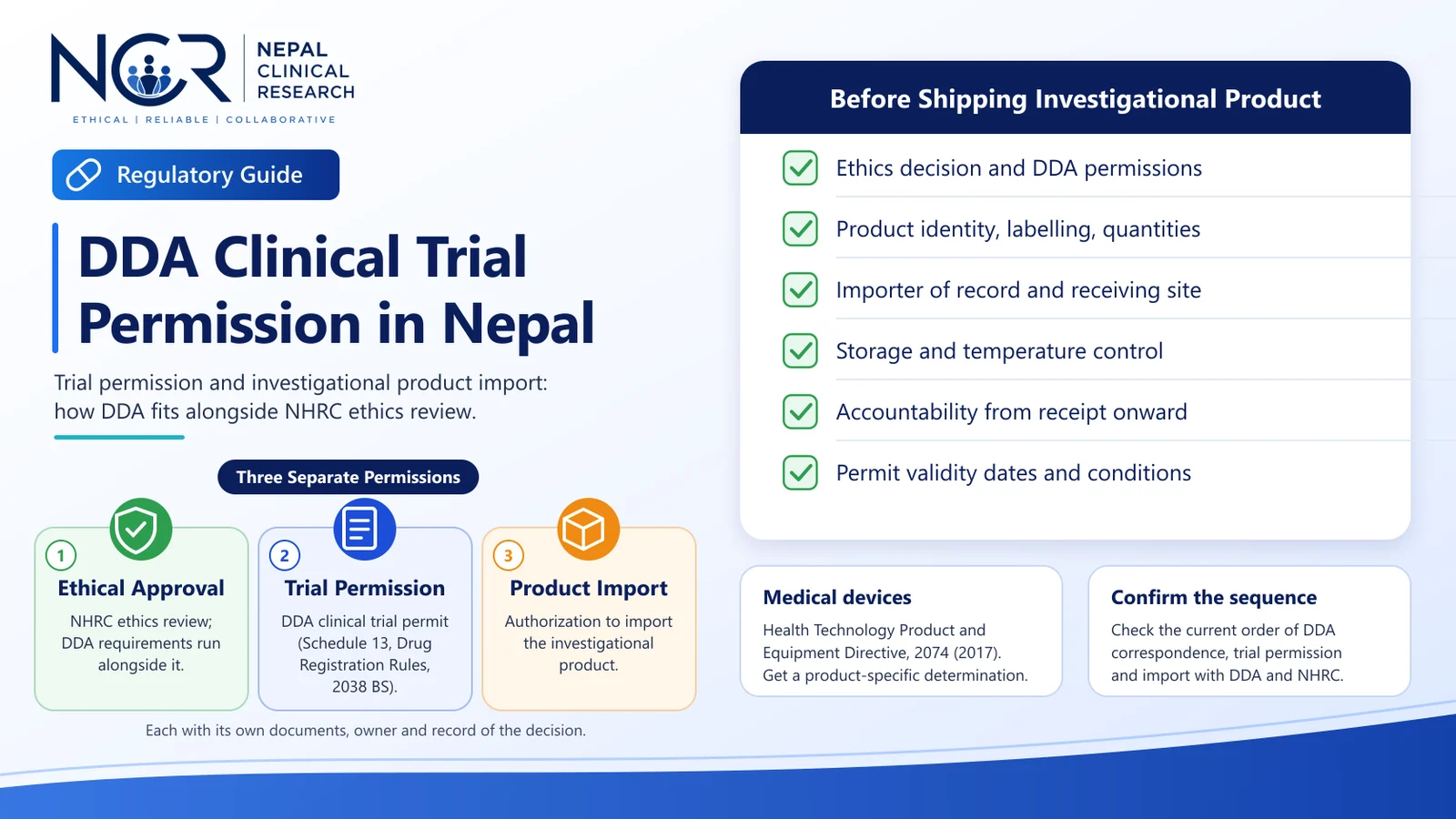
1. What DDA regulates
The Department of Drug Administration (DDA) is Nepal's medicines regulator. Its published role includes issuing clinical trial permits and regulating medicines and health technology products. For a drug or vaccine trial, DDA requirements run alongside NHRC ethics review; neither replaces the other.
2. Three separate permissions
Ethical approval, trial permission and authorization to import the investigational product are distinct decisions. Plan each one with its own documents, owner and record of the decision. Institutional permission to use a hospital's resources is a further, separate matter.
| Permission | Who decides | What it covers |
|---|---|---|
| Ethics approval | NHRC Ethical Review Board, or a recognized IRC within its remit | Whether the research is ethically acceptable and participants are protected |
| Clinical trial permit | DDA | Regulatory permission to conduct the trial with the investigational product |
| Investigational product import | DDA | Authorization to bring the product into Nepal for the trial |
| Institutional permission | Each participating institution | Use of the institution's staff, facilities and records |
3. The legal basis for the trial permit
The clinical trial permit is described in Schedule 13 of the Drug Registration Rules, 2038 BS, listed by the Nepal Law Commission. Use the current official text and DDA's current instructions rather than older summaries or translations.
4. Sequence: confirm it for your product
NHRC's 2022 submission checklist (Annex II) asks for product-related authority documents with a trial submission, while section 7.1 of the same guidelines describes an investigational product import licence after NHRC approval. These address different documents at different stages. Treat the route as a set of dependencies rather than one fixed sequence, and confirm the current order of DDA correspondence, trial permission and import with both DDA and NHRC before you plan dates.
5. Before shipping investigational product
Do not ship until the required authorizations are in place and the receiving arrangements are confirmed.
- The written ethics decision and DDA permissions that apply to the trial
- Product identity, formulation, labelling and quantities matching the authorization
- The importer of record and the receiving site
- Storage and temperature-control arrangements, including during transport
- Accountability records from receipt to dispensing, return or destruction
- Permit validity dates and any conditions attached
6. Medical devices and health technology products
DDA's Health Technology Product and Equipment Directive, 2074 (2017) sets out the framework for health technology products. A drug-trial phase model does not automatically fit a device investigation. NHRC's 2022 guidance addresses device risk and the consent and follow-up implications of implanted devices. Obtain a product-specific determination; a device's commercial availability elsewhere is not a substitute for Nepal requirements.
7. Observational studies
DDA's trial and import role should not be applied indiscriminately to observational research that does not assign an investigational product. Those studies still need the appropriate ethics route and authorized access to records. If the classification is unclear, document a study-specific determination.
Common questions
Clarify the scope.
Does NHRC ethics approval also authorize a drug trial in Nepal?
No. Ethics approval and DDA trial permission are separate decisions. A drug or vaccine trial also needs authorization to import the investigational product.
Does every study need a DDA clinical trial permit?
No. The permit concerns trials with investigational products. Observational research generally falls outside DDA's trial role, but confirm the classification for your protocol.
When can investigational product be imported?
NHRC's 2022 guidelines describe an import licence after NHRC approval. Confirm the current sequence and conditions with DDA for your product before arranging shipment.
What are the DDA fees and timelines?
Check them directly with DDA. This guide does not state fees or timelines because they can change and depend on the application.
Editorial disclaimer. This article is general guidance based on published DDA, NHRC and Nepal Law Commission sources. It is not a regulatory determination. Confirm current requirements, forms, fees and sequence with DDA and NHRC for your specific product and protocol. Last researched: 17 October 2026.
This guide is educational and based on the public sources it cites. It has not been reviewed by an independent regulatory specialist, and it does not replace a protocol-specific decision by NHRC, DDA or the responsible institution. To report an error or an out-of-date requirement, email info@nepalclinicalresearch.com.
Related pages

A study-specific conversation
Let’s clarify what your study needs.
Start with a clear brief. Shape the right support around your study.