Sponsor guide
Choosing a CRO in Nepal
What a clinical research organisation (CRO) in Nepal should help with, the questions to ask before you engage one, and the responsibilities that stay with the sponsor.
Source-based guidance · not a regulatory determination
Explore all insights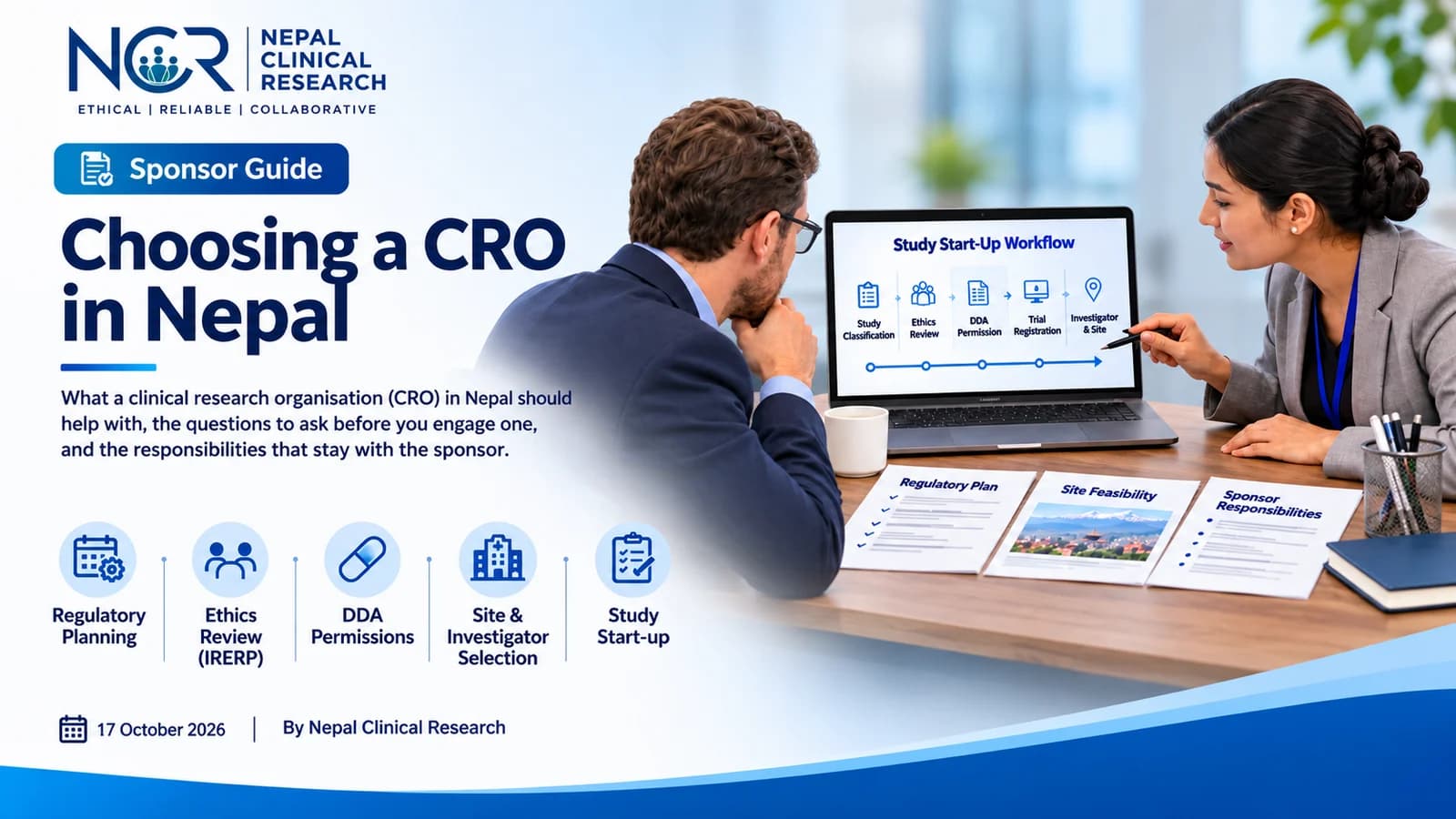
AI-generated illustration. The people shown are not real.
1. Know what local CRO support should cover
A clinical research organisation (CRO) in Nepal connects a sponsor's protocol with Nepal's requirements and the people who will deliver the study. For most sponsors and international CROs, the first need is local regulatory coordination and study start-up rather than a full outsourced programme.
- Classifying the study: observational research, interventional research or a drug, vaccine or device trial
- Routing ethics review between NHRC's Ethical Review Board (ERB) and a recognized Institutional Review Committee (IRC)
- Establishing Department of Drug Administration (DDA) requirements for trial permission and investigational-product import
- Planning trial registration alongside, not instead of, ethics review
- Identifying a qualified Nepalese investigator and institution
2. Start with a written scope
A CRO performs the activities agreed with the sponsor, from individual functions to a broader operational programme. Under ICH E6(R3), a sponsor can transfer trial-related activities to a service provider but keeps overall responsibility for the trial. Agree in writing which activities are required, who will perform them, how they will be reviewed and what evidence will show completion. Keep sponsor and investigator obligations distinct.
3. Test the CRO's knowledge of the Nepal pathway
Ask the CRO to explain how your specific study would move through Nepal's reviews. A useful answer depends on the protocol, intervention, risk, funding and participating institutions; a generic dossier or a fixed promised timeline is a warning sign.
- Which ethics route applies, and whether an IRC's recognized remit covers the study
- How new proposals are submitted through NHRC's Integrated Research Ethics Review Platform (IRERP)
- Whether DDA trial permission and investigational-product import authorization apply, and in what sequence
- How the trial will be registered, and whether a WHO Primary Registry record is also needed
- How progress reports, amendments, extensions and safety reports will be tracked after approval
4. Confirm the Nepal investigator arrangements
NHRC 2022 section 3.9.3 calls for a Nepalese principal investigator in international collaborative research. Ask how the CRO will identify a qualified investigator and institution, what institutional support and permissions are needed, and how participant care, safety and records will be arranged. Home-country approvals do not replace Nepal review.
5. Ask for evidence, not just claims
Assess the team that will actually work on your study. Request evidence you can verify before relying on any statement about capability.
- Company registration details and the named people assigned to your study
- Relevant qualifications and GCP training for those people
- Written procedures for document control, review and escalation
- References or examples shared with the permission of the organisations involved
- A clear statement of which services are available now and which are not
6. Base site selection on feasibility evidence
Country and site selection should follow documented evidence from candidate institutions. Ask how the CRO will review eligible patient pathways, competing studies, investigator time, consent languages, laboratory capability, emergency care, storage, transport and records. Population size and disease burden alone do not demonstrate recruitment capacity or site readiness. The site feasibility checklist in Insights can structure that review.
7. Where Nepal Clinical Research fits
Nepal Clinical Research (NCR) is a clinical research organisation (CRO) based in Nepal. We support studies for sponsors and CROs from feasibility and start-up through monitoring and close-out: study classification, NHRC ethics review, DDA permission, trial registration, identifying a qualified Nepalese investigator and site, monitoring, site management, safety reporting, data and trial documents, close-out, and archiving study files until the retention period ends. We also manage clinical trial logistics: investigational product import, cold chain, lab kits and sample shipment. Begin with a non-confidential synopsis; please do not send patient information or confidential trial documents through this website.
Common questions
Clarify the scope.
Does using a CRO transfer the sponsor's responsibility?
No. Under ICH E6(R3), a sponsor can transfer trial-related activities to a service provider, but the sponsor keeps overall responsibility for the trial. Agree the transferred activities and oversight in writing.
Which approvals does a clinical trial in Nepal usually involve?
Ethics review by NHRC's Ethical Review Board or a recognized Institutional Review Committee within its remit, DDA trial permission and investigational-product import authorization for drug or vaccine trials, institutional permissions and trial registration. Obtain a study-specific determination; registration does not authorize recruitment.
Can a CRO guarantee approval timelines in Nepal?
No. Review scheduling, fees and conditions are set by NHRC, DDA and the participating institutions. Check current requirements directly with them before planning dates.
What does Nepal Clinical Research offer today?
Feasibility, regulatory coordination and study start-up in Nepal (study classification, NHRC ethics review, DDA permission, trial registration and identifying a qualified Nepalese investigator and site), then monitoring, site management, safety reporting, data and trial documents, close-out, and archiving study files until the retention period ends. We also manage clinical trial logistics: investigational product import, cold chain, lab kits and sample shipment.
This guide is educational and based on the public sources it cites. It has not been reviewed by an independent regulatory specialist, and it does not replace a protocol-specific decision by NHRC, DDA or the responsible institution. To report an error or an out-of-date requirement, email info@nepalclinicalresearch.com.
Sources and further reading
Additional Resource
- NHRC — National Ethical Guidelines for Health Research in Nepal (2022)
- NHRC — Guidelines for Institutional Review Committees (2016)
- Department of Drug Administration — Regulatory role
- ICH — E6(R3) Good Clinical Practice, Principles and Annex 1 (2025)
- NHRC — Notice: Submission of New Research Proposals Through IRERP (24 June 2026)
- WHO — Other registries, including Nepal
Related pages

A study-specific conversation
Let’s clarify what your study needs.
Start with a clear brief. Shape the right support around your study.